Reflections on the Prevent to Protect through Support (2PS) “Risk and Desistance Hexagon” training
By Kieran McCartan, PH.D., Kasia Uzieblo, Ph/D., Sophie King-Hill, Ph.D., & Josie Solle, B.A
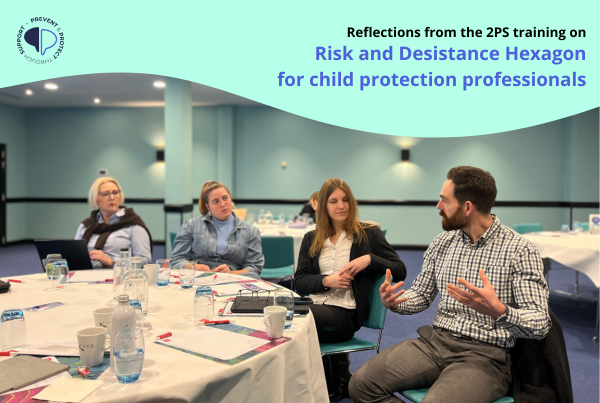
On the 30th of January 2025, the Prevent to Protect Through Support (2PS) project held its second professional networking and training event in Brussels. The networking event focused on the importance of understanding risk and risk assessment in the prevention of child sexual abuse.
The training on Risk and Desistance Hexagon
Risk assessment is often a challenging area of professional practice because of its links to sentencing, treatment planning, release, community integration and public protection. Assessing risk is a significant foundation in modern societies’ (especially northern hemisphere and westernized societies) approach to preventing future sexual offending, reducing victimization and managing challenging as well as dangerous individuals.
However, it is also a contested area with several different risk assessment approaches (i.e., the use of actuarial risk assessment scales, structured professional judgment, clinical insights, etc), several different risk assessment scales and tools, as well as different professional, cultural and country-based attitudes to and understanding of good practice.
This means assessing risk and developing good evidence-based practice looks different- organisationally, nationally and transnationally. This poses an issue for the development of coherent national and international standards on the matter.
Therefore, we have a challenging and hotly debated landscape that can be confusing for professionals and policymakers, never mind the public.
The development of the “Risk & Desistence Hexagon”
For many years, the focus of understanding risk was based on reducing re-offending, managing challenging people in the community and public protection; however, with increasing conversations and frontline practices focusing on preventing first-time offending, the assessing risk conversation has moved upstream.
Preventing first-time offending, especially sexual offending, is challenging -at best- for many reasons. Aside from professional attitudes to risk assessment, including a lack of information, a lack of guidance, and a lack of evidence bases to compare the individual back to, there is crucially a lack of professional experience in doing this work.
As part of the 2PS project, Professor Nicholas Blagden was tasked to develop a secondary prevention tool to help professionals assess the risk of first-time offending as well as to understand the early career offending behaviours of people at risk of committing a sexual offence.
The idea of assessing risk in the secondary prevention sphere is challenging. Over the last year, Professor Blagden, with colleagues from the 2PS network, has developed the “Risk and Desistance Hexagon” which is a professional decision-making tool based on a traffic light system to help professionals understand the risk their clients pose and how to plan their service delivery, interventions or referrals appropriately.
It is a living document that can be revisited and built on across the professional’s engagement with their client. The aim of the Hexagon is not to define risk, but rather to assess the risk that a person poses, and to plan accordingly- with the aim of preventing offending behaviour and/or an escalation of offending behaviour.
The event was the first opportunity to road-test the tool with professionals, academics, and practitioners from across Europe; therefore, a good opportunity to gain some insights into the Hexagon and its use.
Academic reflection
Dr Sophie King-Hill: There is something to be said about getting a range of experts in a room, in person, to spend a day picking apart a problem and looking at ways to approach it. The transparency around the tool was useful in relation to its development and intentions.
One key point that is pertinent to any assessment/mapping/planning tool for harmful sexual behaviour interventions is the balance between the complexity that is needed to approach a multi-faceted issue coupled with the simplicity that professionals need. This simplicity is required due to a lack of training, resources and time. There is no easy solution to this thorny problem.
The use of a ‘traffic light system’ is a good example of this – on one hand, it is visual, gives key and immediate indicators as to how urgent an issue is and is easy to understand given its application to everyday life. However, the danger with its simplicity is that it may wash away the context and the professional judgment needed for such complex issues. There is no easy fix for this.
Meeting in Brussels at the 2PS event to discuss the prototype of an important tool gave time for these key issues to be unpicked.
Practitioner reflection
Dr Kasia Uzieblo: Assessing the risk of first-time offending in practice is no simple task; it not only presents practical challenges but also raises important ethical and deontological questions. A fundamental challenge lies in determining when we can realistically speak of a risk group for sexual offending. What signals should practitioners rely on to make such an assessment?
Unlike organizations such as Stop it Now!, which often have a clearer (though not always definitive) framework for identifying individuals at risk, many other services may struggle with these questions. How should frontline professionals, social workers, or helpline responders interpret early warning signs, especially in the absence of a concrete offence?
This is precisely where the Risk and Desistance Hexagon sharpens these questions from practice. Rather than providing rigid categorizations, it offers an evidence-based tool to facilitate structured decision-making, particularly in areas such as child protection. The Hexagon does not claim to define risk in absolute terms but rather equips professionals with a structured approach to assess potential concerns and determine appropriate actions.
As the coordinator of a frontline helpline for people affected by violence, sexual abuse, and child maltreatment, I see the potential of the Hexagon in certain cases. Its structured framework makes it accessible for professionals in different settings, including frontline services.
At the same time, we experience a need for a tool that supports decision-making regarding (acute) risks and advisory processes, particularly based on information obtained solely from victims or their surroundings. These cases present unique challenges, as risk assessment often relies on fragmented information, making structured guidance even more crucial.
In addition, for this tool to have its full impact, it will be essential to ensure that decision-makers at various levels, across different settings, are also aware of its existence and application or at least be aware of the evidence base concerning risk and desistance factors.
Developing a shared language and vision across different settings and professions remains crucial, as continuity in assessing risks and intervention is key to effectively preventing harm. These discussions will be instrumental in refining the tool further and exploring its validity and integration into existing risk management frameworks.
Conclusion
Over the next couple of months, the Hexagon will be piloted across a broad European professional network as part of its development process. If you would like to learn more or attend a piloting event, please get in touch with the 2PS team. The next 2PS professional engagement and networking event will be on the 26th of August in Poznań, Poland as part of the International Association for the Treatment of Sexual Offenders (IATSO) conference.